What is a HACCP plan template?
A HACCP plan template gives your team a structured way to spot food safety hazards and stay in control at every stage of production, from receiving raw materials to serving the finished product.
HACCP stands for Hazard Analysis and Critical Control Points. It is a food safety system used to identify and manage biological, chemical, and physical hazards across storage, transport, preparation, and sale. A HACCP plan also pinpoints the critical control points in your process, the exact steps where a hazard can be prevented, eliminated, or reduced to a safe level.
Getting this right is not just about compliance. A solid HACCP plan protects your customers, your reputation, and your business from the cost of a foodborne illness incident.
Why do I need it?
A HACCP plan is one of the most cost-effective ways to protect your food business. Here's what it gives you:
Capture CCP monitoring data in real time, from any device — no paper logs, no transcription errors, no compliance gaps
Avoid costly fines tied to food safety and hygiene breaches
Build a reputation customers and regulators trust
Reduce downtime by catching issues before they escalate
Provide a due diligence defense if a food safety issue is ever investigated
HACCP regulatory requirements: FDA vs. USDA
Requirements vary depending on what you produce and where you operate:
FDA | USDA | |
|---|---|---|
Covers | Most food products (produce, dairy, seafood, juice) | Meat, poultry, and processed egg products |
Legal basis | FSMA preventive controls + HACCP for seafood/juice | Mandatory HACCP under FSIS regulations |
Plan focus | Hazard analysis + preventive controls | 7-principle HACCP plan per product line |
If you export or supply internationally, check requirements against Codex Alimentarius, the global reference standard most national regulators build from.
What to Include in a HACCP Plan Template
Since a HACCP plan requires a very specific set of items to go through, a HACCP plan template typically includes the following elements:
Title Page – Add the key information needed for the specific use such as reference number, establishment name, intended use and consumer, and important dates to note.
Process – Specify the manufacturing procedure to be assessed. A manufacturing process can comprise multiple steps so make sure to include all of these.
Hazard analysis – Identify potential hazards in the food production process including biological, chemical, and physical hazards. This analysis helps determine the CCPs where control measures can be implemented.
CCPs – Determine the critical control points in the production process where control measures can be implemented to prevent, eliminate, or reduce the identified hazards.
Critical limits – Define the specific criteria for each CCP that must be met to prevent or eliminate the hazard, such as temperature, pH, time, and moisture.
Monitoring procedures – Establish how the CCPs will be monitored, who will perform the monitoring, and how frequently. Monitoring ensures that the critical limits are being met and that the control measures are working effectively.
Corrective action – Specify the actions that will be taken if the critical limits are not met, such as adjusting the process, reworking the product, or discarding it totally.
Completion – Complete the template used by adding a digital signature of the assigned employee.
How to Write a HACCP Plan with a Template
An effective HACCP Plan follows seven principles. Here’s a quick structured guide on how to start developing your HACCP plan using a checklist in three general steps.
Principle #1: Write down your process
Building a HACCP Plan begins with listing down the steps in the production process. This step involves conducting the HACCP principle of conducting a hazard analysis. Therefore, you have to write down the following information:
General description of the step or process;
Likelihood of potential hazards it’s exposed to (e.g., biological, chemical, or physical);
Preventive measures including photos of the process or procedure for a more comprehensive plan.
Principle #2: Determine CCPs and establish critical limits & monitoring procedures
In this step, you will need to identify which processes a critical control point (CCP) must be applied to eliminate food safety hazards (e.g., receiving, sorting, handling, or testing). As you write down critical control points, a critical limit should also be specified. A critical limit is the minimum or maximum value that must be met by the control measure to prevent, eliminate or reduce the hazard.
After establishing the critical limits, a monitoring procedure should then be provided to help the staff track that each limit has been met. This enables staff to maintain food safety during the food production process. Monitoring procedures can be written by defining the following:
What is being monitored?
How should it be measured?
How frequent should it be checked?
Who is responsible for checking?
Example:
Critical Control Point (CCP) | Critical Limit | Monitoring Procedure |
Testing | pH of 4.6 or below | Use a pH meter to measure the pH of the finished product. This should be done for every batch by the Chef in charge or any other designated employee. |
Principle #3: Provide a corrective action
Corrective actions are the steps taken when deviation occurs during the food production process. This allows staff members to take the proper action needed to prevent contamination or any other foodborne illnesses. Corrective actions can vary to either, recooking or reheating or disposal.
Example of a corrective action: If the finished product is slurry and did not meet the critical limit, the food product and its batch should be discarded.

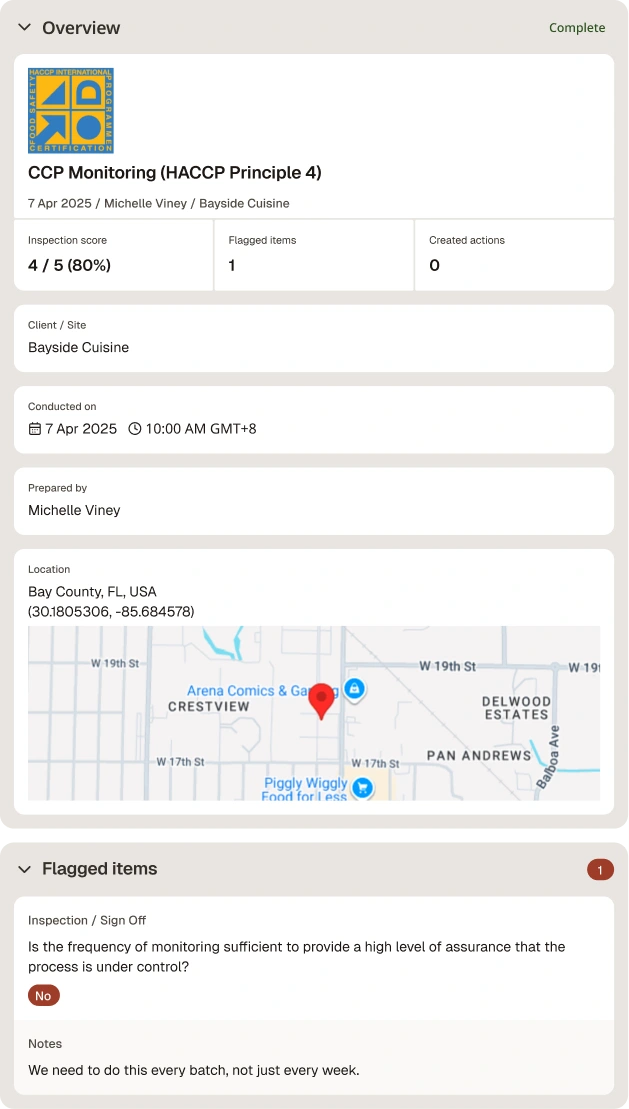
HACCP Plan Monitoring Template Sample Report | Mitti (by SafetyCulture)
HACCP in practice: industry examples
Restaurant: a critical control point might be cooking chicken to an internal temperature of 165°F (74°C), monitored with a probe thermometer at every batch.
Bakery: a critical control point might be verifying allergen-free zones during cross-contact-sensitive prep, monitored through visual checks and equipment sanitation logs.
Food manufacturing: a critical control point might be metal detection at the packaging line, monitored continuously with automated rejection systems and daily calibration checks.
For a deeper look at applying HACCP to your sector, see HACCP in Hospitality.

Sodexo used Mitti (by SafetyCulture) to digitize HACCP, enabling quick food safety issue resolution. They've digitized 30+ logs at 40% of sites, saving over 83,000 pages. This boosts regulator access and connects frontline staff with management, easing unit managers’ workloads.


Still looking for a checklist?
Search, filter, and customize 60,000+ templates across industries and use cases.