Why Should You Do It?
A project risk assessment is necessary because risk is inevitable and not properly preparing for it can cost time, money, and even the project itself. With clients and other project stakeholders closely following a project’s progress, it’s crucial for project managers to not misstep as even the slightest mistake can negatively impact a client’s perception of the project managers’ quality of work and the company they represent.
One of the best ways to ensure that projects go as planned is to perform regular project risk assessment throughout the project life cycle. Though the beginning of a project is often viewed as the most critical, risks can occur at any time during the project. This means that project managers have to always be prepared to handle risks effectively.
Elements
Project risk assessment is just one element of project risk management. Without the other elements, performing a project risk assessment is not only more difficult, but also less effective.
For example, neglecting the risk identification element of project risk management may lead to less significant or worthwhile risks being included in project risk assessment. Focusing on risks that don’t have a noticeable impact on the project not only wastes time and effort, but also causes more urgent risks to remain undetected.
Another example that shows how one element of project risk management affects the others is not setting up a risk monitoring system right after project risk assessment.
Without risk monitoring, project managers won’t be notified when a risk emerges or its consequences become more severe. Even if all the relevant risks were identified and assessed, the lack of risk monitoring can result in project managers losing opportunities to mitigate those risks that they have prepared for.
How to Assess Project Risks in 5 Steps
Since performing regular project risk assessment is critical to a project’s success, it’s important for project managers to know how to assess project risks. For those who don’t, as of yet, know or for those seeking a refresher on project risk assessment, here’s a 5-step guide on how to assess project risks:
How to Assess Project Risks in 5 Steps
Step #1 Start with What You Know
First, identify expected risks and potential risks. Expected risks are risks that project managers know from past experience will occur at some point in the current project. Potential risks are risks that are not likely to occur but have the possibility of occurring.
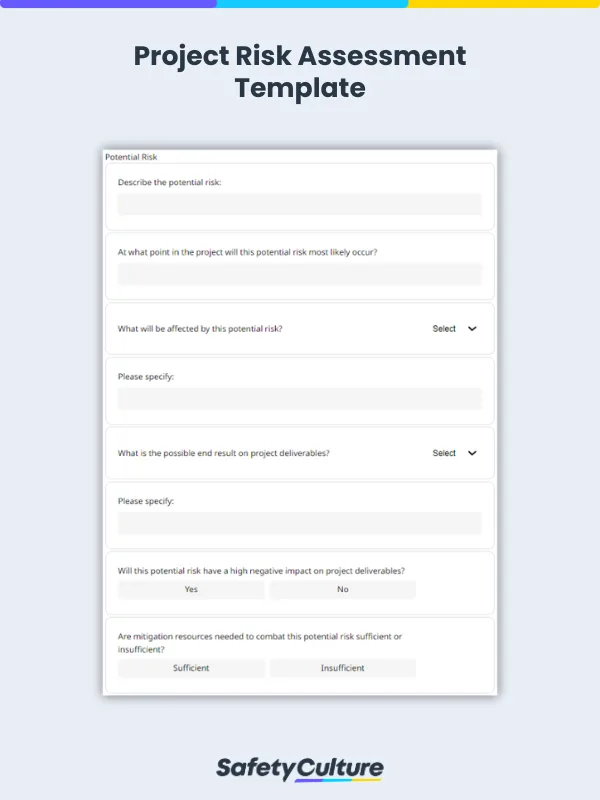
Next, determine if an expected risk is a critical risk or a comfortable risk. Both have a high negative impact on project deliverables. What differentiates the two is if mitigation resources needed to combat a particular risk are sufficient or insufficient. If sufficient, it’s a comfortable risk. If insufficient, it’s a critical risk. Repeat this process for potential risks.
For each risk, identify at what point in the project will it most likely occur, what would be affected (employee productivity, relationship with the client, etc.) and the possible end result on project deliverables (e.g. delayed completion, going over budget, lower quality). Finally, create a comprehensive mitigation plan that covers all the risks identified.
Step #2 Prepare for the Unexpected
Even the best brainstorming technique or risk identification process can’t account for all the risks project managers will encounter throughout their projects. That’s why it’s important to make room for unidentified risks or risks project managers can’t possibly be aware of yet. The only thing project managers can do is form contingency plans for when these risks appear.
While it can be difficult to prepare for something they don’t know about, a tip project managers can use is to make their contingency plans as general as possible. Project managers should be able to adapt and apply these contingency plans to different kinds of risk.
Step #3 Ensure that Everyone Knows What to Do
After establishing contingency plans, project managers have to inform all employees of these plans. If possible, project managers should also hold orientations or training sessions for employees to receive guidance on what to do when risks appear. For the mitigation plan created in the first step, project managers can choose to only inform those assigned specific corrective actions or all employees if their participation is needed.
Step #4 Quickly Adapt to Changes
Once the project starts, the project manager should still be on alert for possible risks. In this step, a tip project managers can follow is to allow and even empower employees to raise risks or bring them to the attention of their supervisors. This is because even the most experienced project managers can miss important risks during risk identification or even during the project. Employees may also have different perspectives on project risks and utilizing their insights can be of great help to project managers.
Step #5 Record What You’ve Learned
Since project risk assessment is a dynamic process, project managers have to constantly evaluate their risk identification, risk mitigation, and risk monitoring. In each evaluation, project managers should take note of what can be improved, what worked, what didn’t work, and what must be done next time to make the project risk assessment more effective.
Why Should You Use a Template?
A project risk assessment template is a convenient, low-cost, digital tool for risk assessment. Unlike a paper document, a digital template is easy to edit, update, and share with large groups of people. Another advantage of using a project risk assessment template is that you can access it on your mobile device or tablet, so there’s no need to carry around an additional folder or binder.
Project risk assessment templates typically contain the following:
Questions to help identify expected and potential risks;
Questions to help determine if a risk is critical or comfortable, when it is likely to occur, what would be affected, and the possible end result on project deliverables;
Risk assessment and mitigation plan, including specific corrective actions assigned to employees;
General contingency plans and how employees will be informed of these plans;
Sections for unidentified risks and risks raised by employees during projects; and
Sections for risk monitoring and documentation.