Mitti by SafetyCulture
Pricing
Log inSign up for free
  1. Home
  2. Checklist guides
  3. Safety
  1. Home
  2. Checklist guides
  3. Safety
Mitti by SafetyCulture

The way the world works

Follow us

App Store
Google Play

Product

  • Pricing
  • Book a demo
  • Product updates
  • Mitti (by SafetyCulture)

Support

  • Help center
  • Contact us
  • API developer documentation
  • Digitize your checklist

Resources

  • Content library
  • App & software guides
  • Checklist guides
  • Topic guides
  • eBooks
  • Blog

Company

  • About
  • Careers
  • News room
  • Meet the leadership team
  • Events & webinars
Copyright © 2026 Mitti
StatusLegalPrivacyTerms & ConditionsSecurity

SafetyCulture has a new name. Say hello to Mitti. Learn More.

Use template
  • What is an Excavation Risk Assessment Template?
  • Why Use Excavation Risk Assessment Templates
  • What to Include in this Template
  • How to Conduct an Excavation Risk Assessment with a Template
  • FAQs About Excavation Risk Assessment Templates

In this article

  • What is an Excavation Risk Assessment Template?
  • Why Use Excavation Risk Assessment Templates
  • What to Include in this Template
  • How to Conduct an Excavation Risk Assessment with a Template
  • FAQs About Excavation Risk Assessment Templates

Eliminate paperwork with digital checklists

Skip the setup and get to work in seconds.

Use template

Article by

Jona Tarlengco

|

4 min read

|

21 Aug 2024

What is an Excavation Risk Assessment Template?

An excavation risk assessment template is a standardized document or form used by organizations, construction companies, or project managers to evaluate and manage the potential risks associated with excavation work. Excavation activities involve digging, trenching, or digging below the ground surface to create holes or cavities, often for construction, utility installations, or archaeological purposes. These activities can pose various safety and environmental hazards, and a risk assessment template helps identify, assess, and mitigate such risks.

Why Use Excavation Risk Assessment Templates

The Occupational Safety and Health Administration (OSHA) states that excavating is recognized as one of the most hazardous construction operations. In some situations, hazard potential increases, especially after rainstorms and when fissures, tension cracks, and water seepage occur.

Hence, an excavation risk assessment is performed to determine and decrease safety risks before trenching and excavating activities. This type of risk assessment should be carried out at least daily and before the start of each shift to protect workers from cave-ins. Also, this helps make sure that protective systems such as sloping, benching, shoring, shielding, and other engineering controls are properly in place and good condition.

For this, excavation risk assessment templates help offer a structured approach to identifying, evaluating, and mitigating the potential hazards involved in this job. Apart from that, here are other reasons why using these templates is a must:

Standardization of Safety Practices

By using templates for excavation risk assessments, organizations can standardize safety practices across various projects. This consistency ensures that every excavation site undergoes a thorough risk assessment, minimizing the likelihood of oversight or missed hazards.

Compliance with Regulations

Excavation work is subject to numerous safety regulations and standards. Using a template helps ensure that all legal requirements are met, reducing the risk of non-compliance, penalties, and legal liabilities.

Documentation and Record Keeping

Proper documentation is crucial in demonstrating due diligence in excavation safety practices. Hence, templates help create a detailed record of the risk assessment, which can be helpful in the event of audits, inspections, or insurance claims.

What to Include in this Template

An effective excavation risk assessment template should cover a range of critical aspects to ensure the safety of personnel, prevent accidents, and comply with regulations. Generally, the following elements and sections must be included in it:

  • Title Page – task/activity details, including the site name, location, date, and personnel involved

  • Risk Assessment – list of identified hazards, their description, the people at risk, controls, risk rating, and recommended actions

  • References – e.g., risk rating matrix and its guidelines

  • Completion Page – names and signatures of the personnel who conducted the risk assessment

How to Conduct an Excavation Risk Assessment with a Template

1. Identify Hazards

Begin by identifying potential hazards associated with the excavation site. Common hazards should at least include cave ins and collapses, electrical hazards, dust and fumes, and trenching accidents. Each hazard should be well documented in the template, detailing its nature and potential impact on workers and the public

2. Determine who might be harmed

Each item from above should also help identify individuals who may be affected by the hazards. Document these groups in your assessment to ensure that all potential risks are considered

3. Evaluate the Risks involved

Assess the likelihood and severity of each identified hazard. Use a risk rating matrix to categorize risks as low, medium, or high. This evaluation should include:

  • The probability of an incident occurring

  • The potential consequences of that incident

Based on this analysis, recommend appropriate control measures to mitigate risks, such as shoring, sloping, or using protective systems

4.Record Findings

Properly document all findings in the excavation risk assessment template. Make sure to capture all necessary documents, photos, and media files if necessary. An Excavation Risk Assessment Report should include :

  • A title page with project details (site name, location, date, personnel)

  • A comprehensive risk assessment section detailing identified hazards, risk ratings, and control measures

  • References to relevant safety guidelines, compliances, and regulations

  • A completion page for signatures of personnel involved in the assessment
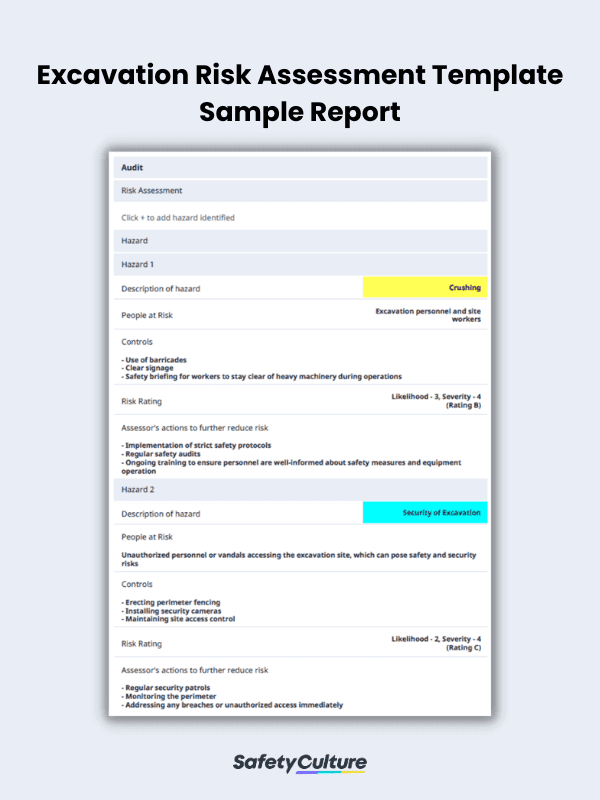
Excavation Risk Assessment Template Sample Report

Excavation Risk Assessment Checklist Sample Report | Mitti (by SafetyCulture)

Content library templates

Still looking for a checklist?

Search, filter, and customize 60,000+ templates across industries and use cases.

Browse Library

FAQs About Excavation Risk Assessment Templates

JT

Article by

Jona Tarlengco

Mitti (by SafetyCulture) Content Specialist

View author profile

Powered by

Excavation Risk Assessment Template

Identify excavation safety issues and improve site teamwork with excavation risk assessment templates.

Rated 4.6/5 stars on Capterra | 3k+ app store reviews
Use templatePreview template
Excavation and Trench Safety
Mobile Preview
See the template in action (opens in new tab)

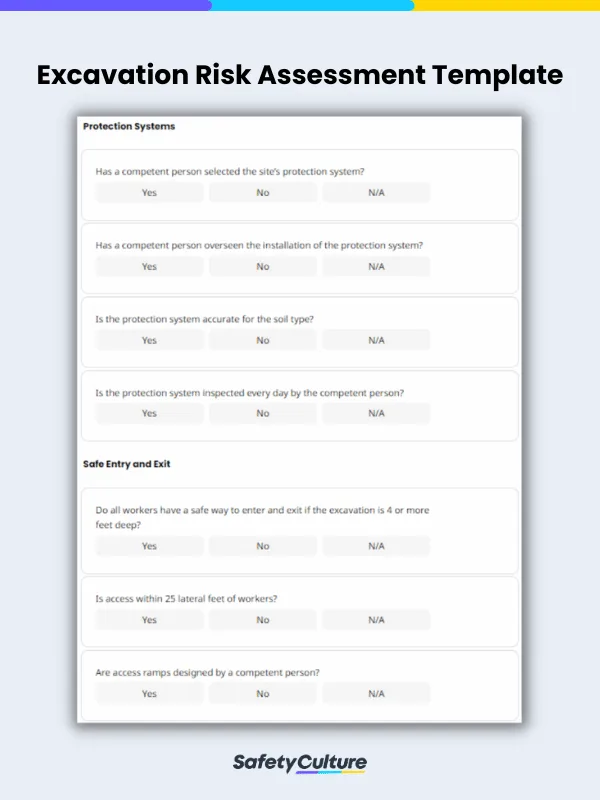
An excavation risk assessment aims to determine hazards and the severity and likelihood of each excavation hazard. Use this template to prioritize which hazards need immediate actions to be controlled or eliminated and do the following:

  1. Document the site name, location, and date of the excavation.

  2. Categorize identified hazards and rate them based on risk assessment matrices using the reference chart included in the template.

  3. Provide controls and preventive measures to improve safety in the workplace.

  4. Have the assessor and other relevant stakeholders sign off the filled-out template before completion.

  5. Export it into an excavation risk assessment PDF, Doc, Excel, and Word report for recordkeeping and store it securely on the cloud.

Excavation and Trench Safety
Mobile Preview
See the template in action (opens in new tab)

Why Mitti digital checklists?

  • Free to use for up to 10 users

  • Eliminate paperwork with digital checklists

  • Generate reports from completed checklists

Related resources you might like

Templates

Powered by

Trenching and Excavation Inspection Checklist - Industry Vetted

Developed by Mitti (by SafetyCulture)’s Industry Expert Partners, this checklist helps identify and mitigate the significant hazards associated with excavation and trenching. With this, users can conduct thorough pre-work checks on general site conditions, protective barriers, soil and water conditions, access/egress, protective systems (sloping, shoring, shielding), hazard controls, environmental factors, equipment/materials, and emergency preparedness to reduce serious injury risks.

View template in library

Powered by

Pre-Start: Excavation Safety Checklist

Use this excavation safety checklist before starting an excavation project. This checklist ensures that workers are properly equipped, prepared, and that the site is safe to work for the day.

View template in library

Powered by

OSHA Toolbox Talk: Excavation Safety

Use this toolbox talk checklist to create comprehensive discussion points for excavation safety and identify common hazards such as cave-ins, falling loads, and hazardous atmospheres. This checklist is also a good venue to communicate follow-up questions or gather feedback from your workers during the talk.

View template in library

Powered by

Excavation Safety Checklist

An excavation safety checklist is a tool used to perform daily worksite and equipment inspections before starting excavation and trenching work. Begin with recording the excavation purpose, dimensions, soil type, protective systems, and equipment being used. Next, evaluate the job site to ensure utilities, barriers, walkways, and warning systems are in place. Also, check if the entry and exit paths are safe and secured.

View template in library

Articles

Safety Audit Software

Discover the most outstanding safety audit software of 2026 and validate your organization’s safety processes with your number one choice.

Learn more

50+ Safety messages of the day

Discover 50+ safety message of the day examples and tips for offices, construction sites, and labs to help keep your workplace safe daily.

Learn more

5×5 Risk Matrix Template

Download free 5x5 risk matrix templates today. Learn how it works and how it can help systematically assess and plan strategies for workplace risks.

Learn more