What is a Food Safety Culture Questionnaire?
A food safety culture questionnaire is a document used in organizations to analyze and ensure the safety of the food they create, prepare, and serve. It can help in identifying issues and gaps in processes, as well as collecting and addressing employee concerns and observations.
Importance and benefits
Food safety culture can be defined as an organization’s collective commitment to ensuring the safety and well-being of those who consume their food products through every facet of its operations. The FDA's Food Safety Culture Blueprint frames this as one of four core elements of its New Era of Smarter Food Safety initiative. This includes adherence to regulations, values, behaviors, and practices that prioritize the production, preparation, and serving of safe and high-quality food products.
However, it can be difficult to measure the success of implementing a food safety culture, hence the need for a food safety culture questionnaire. Using a questionnaire can help an you and your organization better understand how their food products are received, and if their existing processes and procedures are beneficial to them.
A food safety culture questionnaire can also help in assessing current practices if they are compliant with the necessary local and international safety standards for food, worker safety, and workplace operations. Food Standards Australia New Zealand treats culture assessment as core to food safety compliance, and a food safety culture questionnaire can help confirm current practices align with schemes like GFSI's Brand Reputation Compliance Global Standards (BRCGS) Issue 9, which now requires sites to define, measure, and improve their food safety culture.
Other benefits of using a food safety culture questionnaire include the following:
Promoting continuous improvement
Improving transparency among employees and customers with the organization
Reducing downtime caused by issues in food preparation and production
What to include in a food safety culture questionnaire
A typical food safety culture questionnaire has fields for the following:
The employee’s understanding of the following:
Their responsibilities
The value of promoting a culture of food safety
The importance of training
Their supervisors’ attitude towards food safety
Observations on the following:
How issues with food safety are handled
How other employees value or think about food safety practices
How data collection methods are followed and implemented
How the organization, as a whole, values food safety
If you're preparing for a British Retail Consortium (BRC) or Safe Quality Food (SQF) audit, structure these fields around the specific clauses those schemes assess. BRCGS Issue 9 Clause 1.1 and SQF Edition 9 both require a documented food safety culture plan, so group your questions into three areas auditors expect to see, namely management commitment, employee engagement, and communication.
Sample questions that show off these three areas include the following:
Does management visibly prioritize food safety over production speed?
Do you feel comfortable reporting a food safety issue without fear of blame?
Have you received food safety training in the last 12 months?
Do you understand why each food safety procedure exists, not just how to follow it?
Does your supervisor act quickly when a food safety concern is raised?
Are food safety expectations communicated clearly across shifts?
Do you know who to contact if you spot a food safety risk?
Would you describe food safety as "everyone's job" at this site, or just one team's?
Food safety culture questionnaires can come in different types. A digital version with a point scale system that prompts employees to choose a number from 1 to 5 as their response to certain questions, is the most ideal and most simple way to create one. Choosing 1 would mean the employee does not agree with the statement, while choosing 5 would mean they wholeheartedly agree with it. In case of vague responses and feelings, employees can then just choose to add a note to their responses. This direct way of rating and answering can improve response rates, as well as data collection processes.
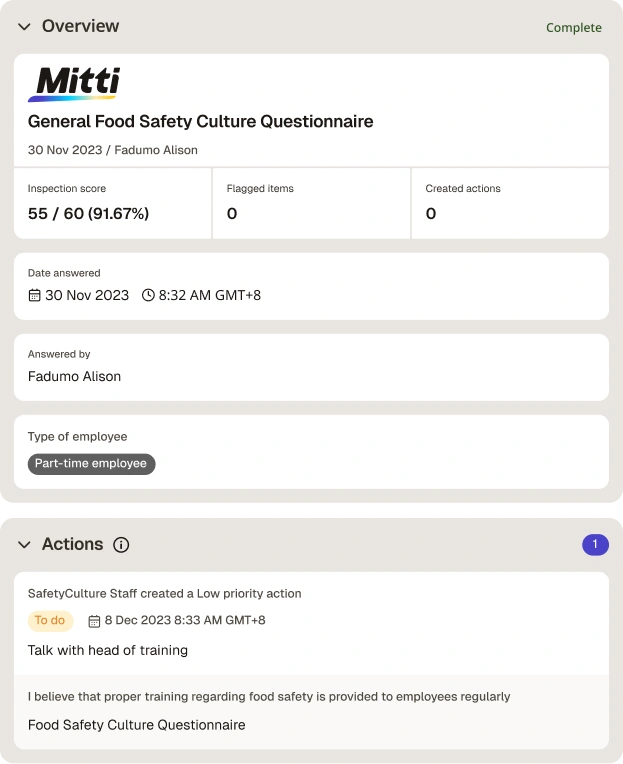
Here is a food safety culture questionnaire example for reference:

Food Safety Culture Questionnaire Sample Report | Mitti (by SafetyCulture)

Still looking for a checklist?
Search, filter, and customize 60,000+ templates across industries and use cases.