What to Include
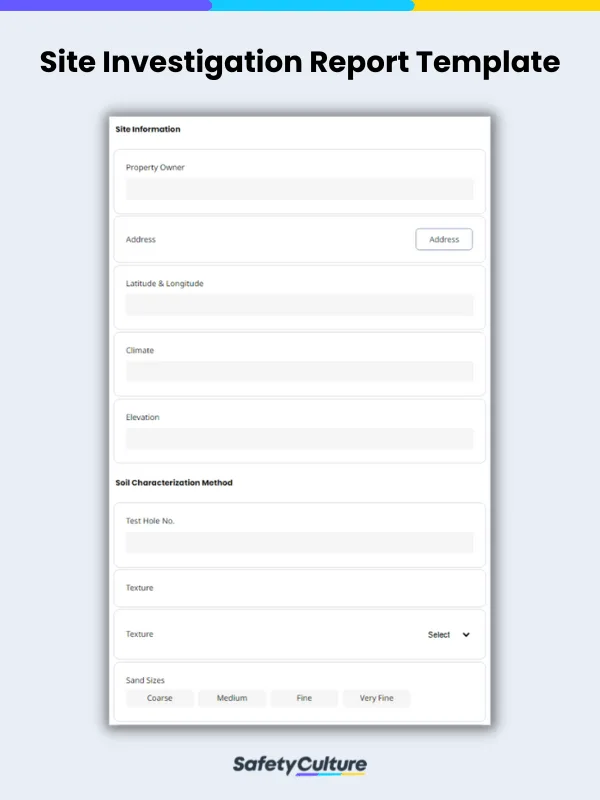
Site investigation report formats vary according to their specific use case, industry requirements, and business needs. Although there’s no exact structure, a general site investigation report typically includes the following items:
Site name/client
Location/site address
Name of investigator/licensed professional
Date and time of investigation
Scope of site investigation
Property owner
Other essential site information (climate, elevation)
Specific details based on the use case (soil condition, safety assessment, geological features)
Recommendations/additional comments
Names and signatures of the investigator and other key people
To increase efficiency and accuracy when creating a report, it is ideal to use pre-made site investigation report templates. These templates contain the essential items that need to be included in the report. They can further be modified according to business needs, hence giving users a head start in completing the investigation.
What is a Site Investigation?
A site investigation, also called geotechnical investigation, is done by taking ground samples for analysis and creating a detailed report of findings and recommendations for the site. It is crucial in helping engineers identify hazards and risks to be mitigated before a construction project begins and determine if a location is ideal for planned development.
Aside from determining suitability for construction, a site investigation helps engineers come up with safe and economical building plans appropriate for the area. It’s also useful in long-term planning because it helps foresee natural or human-made changes and determines corrosivity caused by groundwater conditions.
How to Conduct a Site Investigation
Site investigations are typically composed of and completed through four different stages—reconnaissance, preliminary site exploration, detailed investigation, and laboratory testing. Each stage plays a significant role in the successful culmination of the site investigation and the conclusion of its report.
Stage 1: Reconnaissance
As the first stage of a site investigation, reconnaissance is the visual inspection initially performed on the site. Some of the aspects that this stage reviews are geological and topographical features, the presence of vegetation, and observations about utility lines, among others.
Stage 2: Preliminary Site Exploration
The next stage is the preliminary site exploration or general site exploration. This stage focuses on gaining a general understanding of the sub-soil conditions of the site. Through various ways of soil testing, site exploration aims to know more about aspects such as the soil’s composition and compressive strength, the quality of both the surface water and groundwater, and the depth of soil strata and stratum from the ground level, etc.
In addition, this exploration is normally employed for smaller structures and lighter construction projects.
Stage 3: Detailed Investigation
The third stage, detailed investigation, is perfect for heavy construction projects and more complex structures. The goal of this stage is to obtain an in-depth knowledge on the conditions of the site through a variety of field tests. This is also where the location of trial pits, dynamic probing, and boreholes are identified.
Stage 4: Laboratory Testing
Laboratory testing is the fourth and final stage of a site investigation. As the name suggests, this is where the sample of materials collected through the previous stages are examined. The materials are then classified and provided for the design phase of the project.
Ultimately, a report detailing all the essential information obtained through the site investigation is prepared.
Common Hazards and Risks Uncovered by Site Investigations
Site investigations aim to identify and address hazards and risks that can impact the project and cause problems for its stakeholders. Here are some common hazards that engineers should look out for during site investigations.
Physical hazards
Possible soil oversaturation (too much water) or undersaturation (too dry) can cause foundation issues in the future if not discovered and mitigated.
Engineers should be aware if a site is near an active fault line so that the structure can be built to withstand projected earthquake magnitudes.
Structural hazards from demolished or nearby old structures should be considered while investigating the site.
Natural and manmade disasters that may have rendered a site inhabitable should be checked and mentioned in the geotechnical report.
Chemical hazards
Take samples for lab testing to determine if there are chemical hazards in the soil or underground water due to contamination caused by nearby agricultural, manufacturing, or mining activity, among others.
Demolished old structures near a site need to be tested for traces of asbestos.
Biological hazards
Soil and water samples taken from the site will help determine if nearby industries may have caused biological hazards.
Consider former landfills and waste treatment in the area when checking the site for biological hazards.
Environmental and Social hazards
Consider the project’s impact on the environment’s flora and fauna. Assess the environmental risk to help avoid future issues.
Be aware of social risks, particularly in high-density urban sites or indigenous territories. Consult the government and local stakeholders on the possible social impact to and by the project.