Mitti by SafetyCulture
Pricing
Log inSign up for free
  1. Home
  2. Checklist guides
  3. Safety
  1. Home
  2. Checklist guides
  3. Safety
Mitti by SafetyCulture

The way the world works

Follow us

App Store
Google Play

Product

  • Pricing
  • Book a demo
  • Product updates
  • Mitti (by SafetyCulture)

Support

  • Help center
  • Contact us
  • API developer documentation
  • Digitize your checklist

Resources

  • Content library
  • App & software guides
  • Checklist guides
  • Topic guides
  • eBooks
  • Blog

Company

  • About
  • Careers
  • News room
  • Meet the leadership team
  • Events & webinars
Copyright © 2026 Mitti
StatusLegalPrivacyTerms & ConditionsSecurity

SafetyCulture has a new name. Say hello to Mitti. Learn More.

Powered by

VACCP Plan Template

Report food fraud proactively and streamline VACCP compliance using your mobile device.

Rated 4.6/5 stars on Capterra | 3k+ app store reviews
Use templatePreview template
VACCP Plan Template
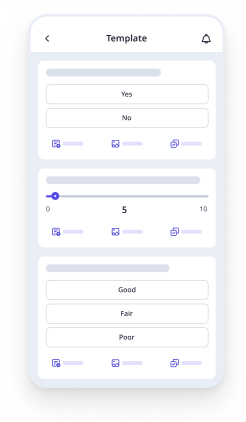
Mobile Preview
See the template in action (opens in new tab)

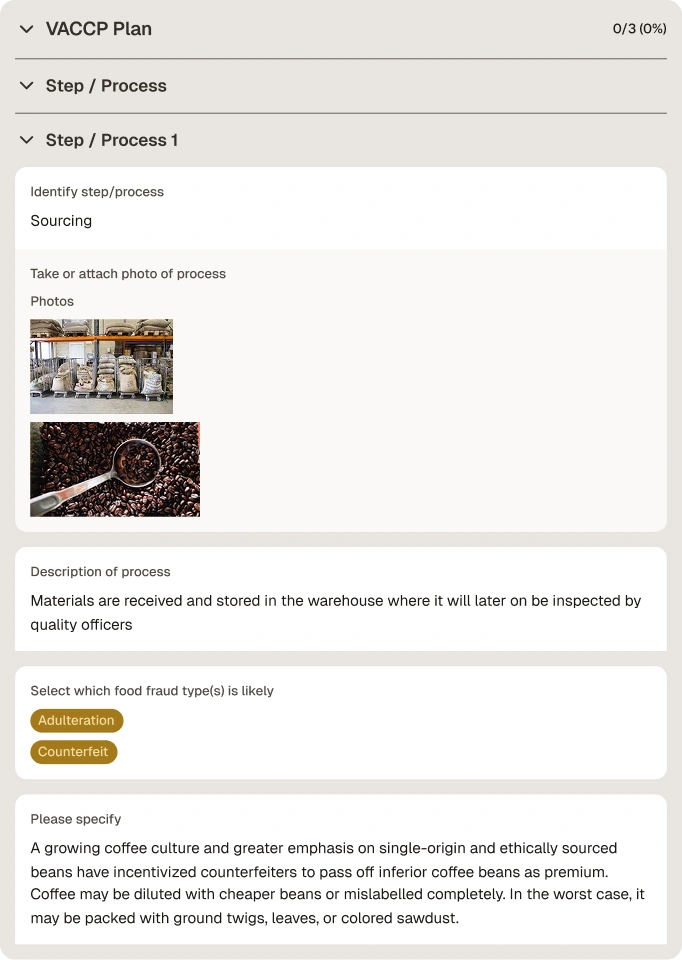
A VACCP plan template is used to identify and control vulnerabilities in the supply chain process to prevent food fraud. Manufacturing managers can use this template to establish a food safety system for their business as a requirement for food safety certifications. This template allows inspectors to do the following:

  1. Define steps/processes

  2. Take or attach photos of the process

  3. Identify food fraud type and evaluate its likelihood and consequence, V-CCP (if any) and its corrective measures.

  4. Determine V-CCP and establish its critical limits and monitoring procedures

  5. Conclude the inspection with recommendations and digital signature.

VACCP Plan Template
Mobile Preview
See the template in action (opens in new tab)

Why Mitti digital checklists?

  • Free to use for up to 10 users

  • Eliminate paperwork with digital checklists

  • Generate reports from completed checklists

Use template
  • What is VACCP?
  • What is a food fraud mitigation plan?
  • Is Food Fraud Illegal?
  • Food Fraud Types
  • HACCP, TACCP, VACCP: What’s the Difference?
  • Food Fraud Vulnerability Assessment Example

In this article

  • What is VACCP?
  • What is a food fraud mitigation plan?
  • Is Food Fraud Illegal?
  • Food Fraud Types
  • HACCP, TACCP, VACCP: What’s the Difference?
  • Food Fraud Vulnerability Assessment Example

Eliminate paperwork with digital checklists

Skip the setup and get to work in seconds.

Use template

Article by

Jona Tarlengco

|

4 min read

|

21 Jun 2024

What is VACCP?

VACCP stands for Vulnerability Assessment Critical Control Points. Also called the Food Fraud Vulnerability Assessment, VACCP is a systematic method that proactively identifies and controls food production vulnerabilities that can lead to food fraud. VACCP aims to help protect businesses from the risk of food fraud that can cause serious food safety incidents, costly product recalls, business closures, and legal action.

What is a food fraud mitigation plan?

After conducting a food fraud vulnerability assessment, a good food fraud mitigation plan must be designed to address all factors identified during the evaluation. GFSI requires proper documentation of the food fraud mitigation plan which also varies depending on the type of business, as well as the products, risks, ingredients, and geographical occupancy. A food fraud mitigation plan should also address areas such as management processes, workplace culture and ethics, supplier management, and food distribution processes.

VACCP Plan Template

VACCP Plan | Mitti (by SafetyCulture)

Is Food Fraud Illegal?

Food fraud is the deliberate “substitution, addition, tampering, or misrepresentation of food, food ingredients, or food packaging” for economic gain. While the consequences of food fraud may mostly go undetected by the human body, this does not nullify its harmful effects. Countless food fraud incidents over the last few decades prove how serious the threat it poses to public health. To prevent these incidents from recurring, food authorities globally have implemented various legal and certification requirements to hold food companies liable for the quality and safety of their products (e.g., FSMA, Regulation (EU) 2017/625). Non-compliance and violation of these food safety regulations and policies can lead to legal repercussions such as fines, suspensions, seizure and detainment of shipments, and worse closure.

Food Fraud Types

Here are some of the types of food fraud and example cases:

  • Counterfeiting – substitution of ingredients and products with similar packaging or the mixing of inferior quality ingredients to increase the volume of products, e.g. counterfeit spices (saffron, oregano, pepper) being mixed with different materials

  • Adulteration – adding ingredients like sugar or sweeteners to honey or maple syrup in order to produce a similar taste while adding volume or, in the case of baby formula, adding melamine to reach the desired “protein” count

  • Dilution – olive oil mixed with other types of oil, wine with grape blends, and fruit juices diluted in water then mixed with other ingredients to produce a similar taste while increasing volume

  • Mislabeling – examples are cases of horse meat mixed with beef but labeled and sold as beef, organic food being sold but found to have traces of “non-organic” ingredients, and mislabeled seafood being sold in the market

HACCP, TACCP, VACCP: What’s the Difference?

While there are control points among the three that overlap, the intention or goal is unique for each of them:

HACCP – stands for Hazard Analysis Critical Control Point and its goal is to identify and mitigate hazards during food production and ensure that the product is safe for consumption

TACCP – stands for Threat Assessment Critical Control Point and it aims to protect food products from deliberate contamination with the intention to cause harm

VACCP – seeks to identify and control vulnerabilities in the food supply chain that can be susceptible to food fraud

Food Fraud Vulnerability Assessment Example

It is highly recommended to monitor raw materials to prevent food fraud during the production process. One of the key areas for inspection is to check the quality of the raw food and its physical condition. Quality metrics should also be included to ensure that food will comply with industry standards. Here is an example of a food fraud vulnerability assessment for raw materials monitoring:

Food Fraud Vulnerability Assessment - Monitoring

Food Fraud Vulnerability Assessment – Monitoring | Mitti (by SafetyCulture)

Content library templates

Still looking for a checklist?

Search, filter, and customize 60,000+ templates across industries and use cases.

Browse Library
JT

Article by

Jona Tarlengco

Mitti (by SafetyCulture) Content Specialist

View author profile

Related resources you might like

Templates

Powered by

V-CCP Monitoring Template - Raw Material Test

This V-CCP monitoring template is used to assess if received raw materials pass material testing. Testing helps control vulnerability in food fraud caused by low-quality raw materials. Take photos of raw materials upon receipt and assign corrective measures in the event that they do not meet critical limits.

View template in library

Powered by

VACCP Supplier Audit Template

Use this VACCP supplier audit checklist to monitor the sourcing process in the supply chain. Keep track of ingredients/raw materials that come in and check for food fraud. Assign corrective measures and generate on-site reports.

View template in library

Powered by

Food Fraud Vulnerability Template - Initial Screening

This digitized template is used for conducting the initial assessment for food fraud vulnerability of a product, ingredient, or raw material. The QA Officer can use this digital form to proactively determine the likelihood of fraud and severity of consequences should food fraud happen. Use this as a guide to do the following:

  1. Conduct a simple and straightforward initial screening for food fraud vulnerability.

  2. Use scoring to measure the likelihood of fraud for the product, ingredient, or raw material. For this template, the lower the total score, the higher is the risk of food fraud vulnerability.

  3. Assign tasks for colleagues to work on based on findings during to the assessment.

  4. Use the online platform to review trends of assessments.

View template in library

Powered by

VACCP template

TACCP and VACCP can be used hand-in-hand with VACCP to promote a strong food defence by going through critical control points that could expose both threats and food fraud vulnerabilities. QA officers can use this to check ingredients or raw materials, product, production line, supplier/s, and nature of business. With other stakeholders to identify risks. Use this checklist as guide for the following:

  1. Assess the possibility of food fraud.

  2. Determine which point in the supply chain fraud can be an incentive.

  3. Check control measures in place against food fraud.

  4. Mitti (by SafetyCulture) templates can be edited according to your business needs – no programming skills needed!

View template in library

Articles

Safety Audit Software

Discover the most outstanding safety audit software of 2026 and validate your organization’s safety processes with your number one choice.

Learn more

50+ Safety messages of the day

Discover 50+ safety message of the day examples and tips for offices, construction sites, and labs to help keep your workplace safe daily.

Learn more

Fuel Safety Inspection Checklist

Use this fuel safety inspection checklist to help gas stations and fleets stay compliant and manage safety effectively.

Learn more