
What is adult learning theory? Principles, andragogy and examples
Adults learn differently from children. See how Malcolm Knowles' principles and other models can make workplace training stick.

Adults learn differently from children. See how Malcolm Knowles' principles and other models can make workplace training stick.
Adult learning theory explains how adults take in, process and use new information. It starts from one idea: adults aren't big children. They arrive with years of experience, firm opinions and a need to know why something matters before they'll put effort into it.
Malcolm Knowles brought the idea into the mainstream with his theory of andragogy, the art and science of helping adults learn. Other researchers have since added models of their own, such as Kolb's experiential learning cycle and Mezirow's transformative learning.
For trainers, supervisors and learning and development (L&D) teams, the difference shows up on the job. Picture a new starter who sits through a two-hour slide deck on manual handling. Now picture one who works through a real lifting task from their own role and talks about what went wrong last time. The second person remembers it.
Get this right and training changes behavior. Get it wrong and people check the box, then go back to old habits. That gap shows up as repeat incidents and repeat training.
Andragogy is the best-known adult learning theory. It sits alongside the other major learning theories used in classrooms and training rooms, but it speaks to people who already have a job, a family and a way of doing things.
Knowles based it on a contrast with how schools teach children. Adults steer their own learning, bring experience with them and want to use what they learn right away. A Journal of Extension article sums up his six assumptions about adult learners:
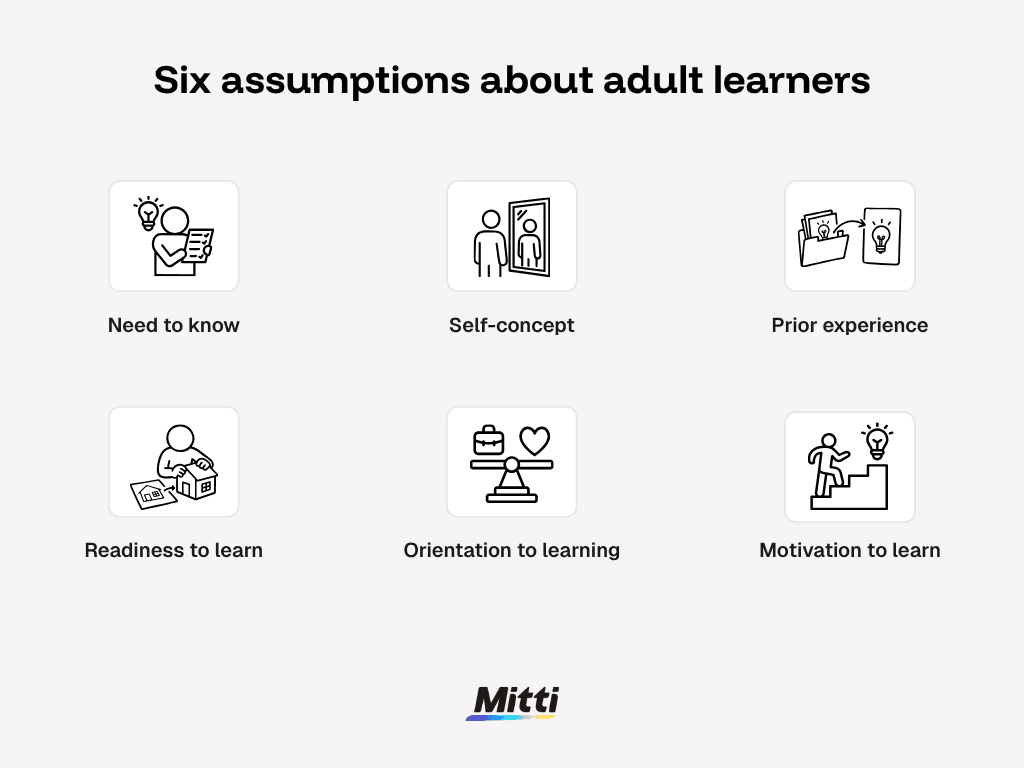
Need to know: adults want to know why they should learn something before they start.
Self-concept: adults see themselves as capable and self-directed.
Prior experience: adults bring a lifetime of experience that shapes how they learn.
Readiness to learn: adults get ready to learn what helps them cope with real situations.
Orientation to learning: adults like to learn around tasks and problems, not abstract subjects.
Motivation to learn: internal drivers like self-esteem and job satisfaction usually beat external rewards.
Knowles' original list had five assumptions, and need to know came later. That's why you'll see lists of five, six or even seven principles online. The ideas stay the same. Our guide to 10 adult learning principles covers each one in more depth.
Start with the why. Tell people what the training prevents or fixes before you teach the steps. A forklift pre-start course lands harder when it opens with the near miss that led to it.
Then use the experience in the room. Ask your most experienced operator to explain how they spot a worn mast chain, then show the checklist. Build each lesson around one real task, like a pre-start on the actual truck, instead of a topic called "equipment safety."
Keep modules short and problem-based. Platforms like Mitti (by SafetyCulture) let you turn an existing SOP or slide deck into short mobile lessons, so people learn at the point of need.
Andragogy isn't the only model, and it has critics. Some researchers argue that no single theory covers adult learning. Three other ideas fill in the gaps.
Theory | Core idea | Best for |
|---|---|---|
Andragogy | Adults direct their own learning and need relevance | Onboarding and course design |
Kolb's cycle | People learn by doing, then reflecting | Hands-on skills and debriefs |
Mezirow's model | Challenged assumptions change habits | Behavior change after incidents |
Self-directed learning | Learners choose and judge their own path | Ongoing upskilling |
David Kolb described learning as a loop with four stages: concrete experience, reflective observation, abstract conceptualization and active experimentation. In plain terms, people do something, think about what happened, draw a lesson and try again.
NIOSH guidance for mine trainers makes the same point: adults learn best by having an experience and reflecting on it. A near-miss debrief fits the cycle well. The crew walks through what happened, names the lesson and agrees what to do differently on the next shift.
Jack Mezirow focused on moments that change how adults see their work. His model starts with a disorienting dilemma, an event that challenges what a person believed. It moves through self-examination, planning and trying new roles before the person settles into a new way of working.
A serious incident can be that trigger. If a team has always skipped lockout steps and a close call shows why that's risky, the debrief is where habits actually change.
Self-directed learning builds on Knowles' idea of self-concept. Adults choose what to learn, set goals and judge their own progress. In training, that means giving people choices. Let them pick the order of modules, test out of content they already know and flag topics they want covered.
You don't need a theory degree to use any of this. Match the model to the training problem:
eLearning: keep each course to one problem and one outcome, and write that outcome with one measurable verb from Bloom’s taxonomy. Add a short scenario question before the explanation so learners see why it matters.
Instructor-led sessions: open with a real incident, give people time to talk through their own experience, then practice the skill on actual equipment.
Engagement and motivation: show how the training makes tomorrow's shift easier. Ask learners to rate the course and act on their feedback.
Four mistakes show up again and again:
Treating a long lecture as training. Adults tune out when they can't use the content.
Skipping the why. People are more willing to follow a rule when they understand the reason.
Ignoring what people already know. Experienced workers feel talked down to when you cover the basics.
Running training once and never checking it worked.
Trippas White Group, the hospitality business behind dining at the Sydney Opera House and the Australian War Memorial, uses Mitti (by SafetyCulture) for training. It has 3,000 people doing training, and its group compliance manager says he manages the program himself because the platform is easy to run.
Onboarding is where adult learning principles pay off fastest. New starters arrive with experience from other jobs, so skip the basics they already know and focus on how your sites do things. Pair each short lesson with a supervised task, then sign it off with an observation checklist so the learning shows up in the work.
Upskilling works the same way. Tie each course to a problem the person faces now, like a new machine or a new regulation. Training managers often rely on tools made for their role to assign courses by role and track who has finished.
Compliance training has a bad reputation because it's often a once-a-year slideshow. Adult learning principles fix that by making the content relevant and giving people a chance to apply it. ISO 10015 sets out guidelines on competence management and people development. It gives you a framework to show auditors how you build and check skills.
Training also supports risk culture, because people who understand why a control exists are more likely to follow it. It ties directly to hazard identification and risk assessment, where on-the-job knowledge decides how well hazards get spotted.
Mitti (by SafetyCulture) is the operations system for every site, shift and standard. Trusted by over 80,000 organizations, Mitti brings your people, operational data and workflows into one operating picture.
From the frontline to the boardroom, it gives everyone a clear understanding of what's happening, highlights what needs attention and recommends what to do next.
✓ See what's happening across every site, as it happens
✓ Spot risks and incidents before they escalate
✓ Turn every issue into a clear next step
✓ Cut the time your teams spend on paperwork
✓ Keep every site to the same standard
✓ Improve every day with evidence from the people doing the work