
What is Bloom's taxonomy? Levels, verbs and examples
Learn the six levels of Bloom's taxonomy, the action verbs for each and how to use them to build better workplace training.

Learn the six levels of Bloom's taxonomy, the action verbs for each and how to use them to build better workplace training.
Bloom's taxonomy is a framework that sorts learning goals by how much thinking they demand. It runs from simple recall at the bottom to creating something new at the top. Trainers and teachers use it to write clear learning objectives and to check whether people can do more than repeat facts.
Benjamin Bloom led the group of educators that published the original version in 1956. A team led by Lorin Anderson and David Krathwohl revised it in 2001, and the revised version is the one most people use today. It has six levels: remember, understand, apply, analyze, evaluate and create.
For workplace trainers, the useful part is the gap it exposes. A worker who can recite a lockout procedure sits at the first level. A worker who can spot a missing step during a live isolation and fix it sits much higher. Training that only tests recall leaves that gap open.
Bloom's taxonomy is one of the most recognized of the major learning theories in education. The 1956 version named its six levels with nouns: knowledge, comprehension, application, analysis, synthesis and evaluation.
In 2001, David Krathwohl (one of Bloom's original collaborators) and Lorin Anderson published a revision that dropped synthesis and moved create to the top level. One summary adds that the revision switched the level names from nouns to active verbs and added a knowledge dimension covering factual, conceptual, procedural and metacognitive knowledge.
For training, use the revised version. Verbs describe what a person does, so objectives are easier to write and to test.
Each level asks for a different kind of thinking. Here's how they look on a worksite:
Level | What it asks | Workplace example |
|---|---|---|
Remember | Recall facts and steps | State the first step of the lockout procedure |
Understand | Explain an idea in your own words | Explain why a lockout tag is needed |
Apply | Use knowledge in a real task | Complete a pre-start inspection on a forklift |
Analyze | Break a problem into parts | Compare two near-miss reports to find the common cause |
Evaluate | Judge using criteria | Decide whether a control is strong enough for the hazard |
Create | Build something new | Write a new procedure after a process change |
Use the table as a quick test. Pick a topic from your own training and write one task for each row.
Remember, understand and apply cover most induction content. They matter, but they only show that someone can follow what they were taught.
Analyze, evaluate and create are the skills workers need when a job doesn't match the procedure. Think of spotting a hazard nobody listed, judging whether a workaround is safe or improving a process after an incident. These levels are hard to test with a multiple-choice quiz, which is why training often skips them.
Most diagrams show the levels as a pyramid with remember at the base. Each level builds on the one below it. One summary notes that research over the last 40 years has confirmed the levels as a hierarchy. In practice, people need to remember a process before they can analyze it and analyze it before they can judge it.
Strong objectives use one measurable verb. "Understand the hazard" is vague. "Explain the hazard to a new starter" is something you can check.
Level | Example verbs |
|---|---|
Remember | List, define, name, recall |
Understand | Explain, summarize, describe, classify |
Apply | Demonstrate, use, complete, carry out |
Analyze | Compare, differentiate, examine, investigate |
Evaluate | Judge, justify, assess, recommend |
Create | Design, develop, draft, build |
Use this pattern: by the end of the session, the learner will [verb] [what] [to what standard].
A weak objective says "understand manual handling." A stronger one says "demonstrate a safe two-person lift using the correct technique." You can confirm the second one on the job with an observation checklist, which is the simplest way to check the apply level.
Keep to one verb per objective. "Explain and demonstrate" mixes two levels, so you can't tell which one the learner missed. Write two objectives instead.
Bloom's work covers three domains, and the six levels above belong to the first:
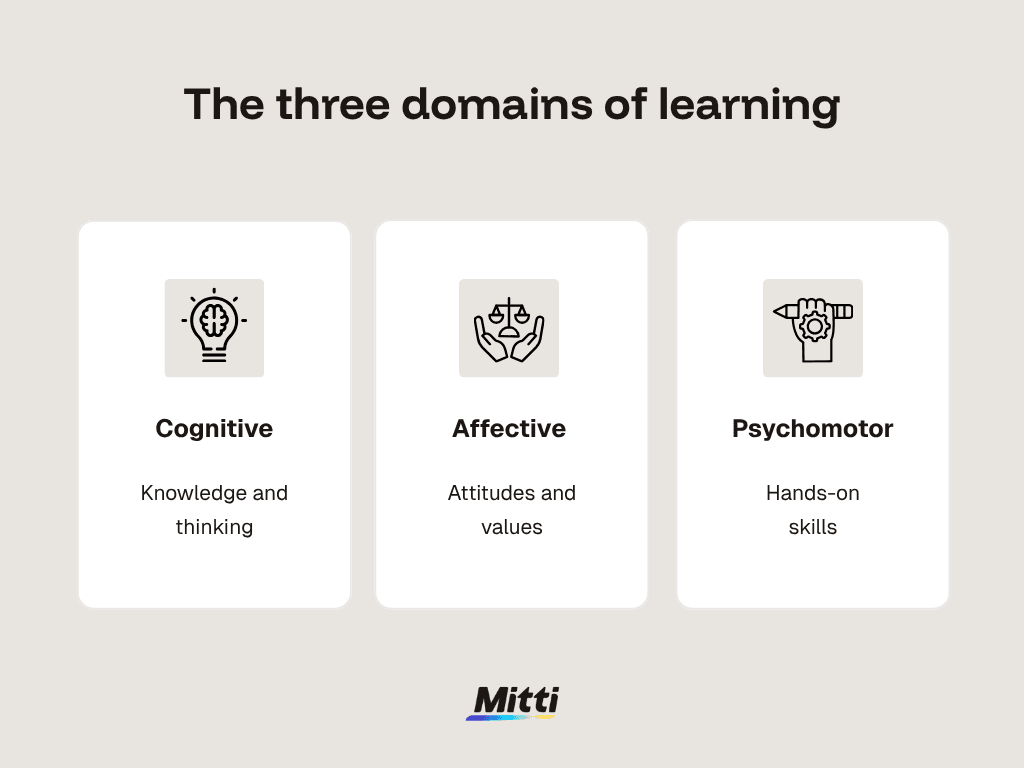
Cognitive: thinking, knowledge and problem-solving.
Affective: attitudes, values and feelings.
Psychomotor: physical skills, like operating equipment.
Safety training touches all three. Knowing the rule is cognitive. Caring enough to follow it is affective. Carrying out the task is psychomotor.
An Occupational Health and Safety magazine article argues that safety professionals need to understand how adults learn as well as they understand the technical content. It points to Bloom's taxonomy as a tool for that. Pair it with adult learning theory to design training people will use.
Choose the level by the risk of the job. A forklift operator needs the apply level, not just remember. A supervisor who investigates incidents needs analyze and evaluate. Day-one starters need remember and understand. By week four, you want to see apply.
Swap recall questions for scenarios. A recall question asks, "What's the first step in the lockout procedure?" An analyze question asks, "The tag is missing from isolation point three. What do you check first and why?" The second question shows whether someone can think, not just remember.
Here's one hazard tested at three levels:
Remember: "What's the load rating on this ladder?"
Apply: "Set up this ladder on the sloped surface and show me your checks."
Evaluate: "A colleague wants to use a damaged ladder to finish a five-minute job. Make the call and explain why."
Check each question against its objective. If the objective says apply but the quiz asks for recall, the assessment is testing the wrong thing.
Start with remember and understand in short lessons. Move to apply with supervised tasks, then to analyze and evaluate in debriefs after near misses. Platforms like Mitti (by SafetyCulture) let you build short courses with quiz questions at different levels, and many training managers use tools made for their role to track who has finished. Review the mix of questions every quarter. If most of them sit at remember, move some up a level.
Sydney Festival uses customized Mitti (by SafetyCulture) templates for inductions, toolbox talks and pre-event checks across 60 venues. In Bloom's terms, inductions and toolbox talks build the lower levels and pre-event checks put apply into practice.
Three mistakes show up often:
Treating the levels as a ranking of workers. The taxonomy classifies types of thinking, not people.
Aiming every course at create. A pre-start check mostly needs apply.
Writing objectives with vague verbs like know or understand.
Mitti (by SafetyCulture) is the operations system for every site, shift and standard. Trusted by over 80,000 organizations, Mitti brings your people, operational data and workflows into one operating picture.
From the frontline to the boardroom, it gives everyone a clear understanding of what's happening, highlights what needs attention and recommends what to do next.
✓ See what's happening across every site, as it happens
✓ Spot risks and incidents before they escalate
✓ Turn every issue into a clear next step
✓ Cut the time your teams spend on paperwork
✓ Keep every site to the same standard
✓ Improve every day with evidence from the people doing the work