
Single-use plastic ban Australia: state and territory guide
A state-by-state look at what's banned, why, and what it means for a business operating in more than one jurisdiction.
A state-by-state look at what's banned, why, and what it means for a business operating in more than one jurisdiction.
There's no single national law behind Australia's single-use plastic ban. Instead, eight separate state and territory governments have each passed their own legislation, with their own banned items list, start date, and penalties. South Australia moved first, in March 2021; a couple of jurisdictions are still finalizing theirs.
That patchwork matters if your business operates in more than one state. An item that's fine to sell in one jurisdiction can carry a fine in the next.
Every state and territory has now committed to phasing out single-use plastics, though the details differ each time. Here's where things stand by jurisdiction:
South Australia — the first state to act, banning plastic straws, cutlery, and stirrers from 1 March 2021, with expanded polystyrene containers and other items added in later stages
Queensland — banned straws, cutlery, plates, and expanded polystyrene food containers from 1 September 2021
Western Australia — rolled out its Plan for Plastics in stages starting 1 January 2022, with most items enforced from 1 July 2022
Australian Capital Territory — banned cutlery, straws, plates, and expanded polystyrene packaging from 1 July 2022
New South Wales — banned straws, stirrers, cutlery, plates, and expanded polystyrene food service items from 1 November 2022
Victoria — banned straws, cutlery, plates, drink stirrers, and expanded polystyrene containers from 1 February 2023
Tasmania — still consulting on a statewide ban; only the City of Hobart currently enforces single-use plastic rules for food retailers
Northern Territory — committed to a phase-out under its Circular Economy Strategy, with no confirmed statewide start date yet
For day-to-day compliance, this means a business with sites in two or three states can be following two or three different rulebooks at once. That's a bigger operational headache than the ban itself.
These rules keep moving, too. Victoria, South Australia and Western Australia all closed further loopholes through 2026, on top of what's listed above — see our closer look attype: entry-hyperlink id: 5bOyjASqz7rakF1BwoxFDpfor what's changed and what's still coming.
If plastic is just one part of what you're managing, ourtype: entry-hyperlink id: 7ufh7C8Dmk916gv8pmjDu3guide covers how Australia's approach compares with other countries, and ourtype: entry-hyperlink id: 7sxh56si4hHayy4jXPno0zguide covers the fundamentals across every waste stream.
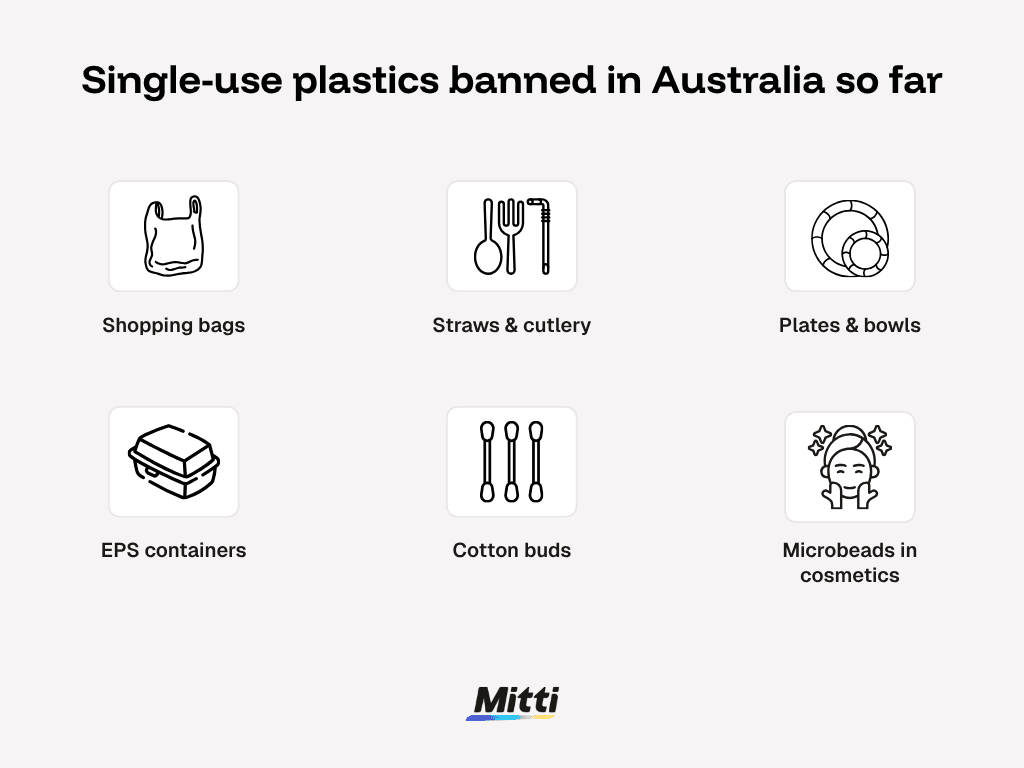
Single-use plastics banned in Australia so far
Despite the differences, most Australian bans target the same handful of items: plastic straws, cutlery, stirrers, plates, bowls, and expanded polystyrene (EPS) food and drink containers. A few states go further — South Australia and Western Australia also restrict plastic-lined coffee cups, produce bags, and pizza savers.
One detail catches businesses out: compostable and "bioplastic" versions of these items are banned right alongside the conventional kind in most states. Labeling a straw as biodegradable doesn't make it exempt — check your state's approved materials list before you restock.
Around 130,000 tonnes of plastic leaks into Australia's marine environment every year, according to the federal government's National Plastics Plan. Straws, cutlery, and food containers are among the most common items found on Australian beaches, and they take decades to break down.
State governments moved on plastics ahead of any national approach because litter and landfill are managed at the state level, and each wanted results faster than a single federal law could deliver. That's also why the bans don't line up — each state built its list around its own waste data and industry consultation.
Exemptions exist in every state, but none of them are automatic. Most cover people with a medical need for plastic straws, and some extend to specific products where a compliant alternative isn't readily available yet. You still need to apply the exemption correctly, not assume it covers your situation.
Penalties scale with the breach. First-time, low-level non-compliance usually gets an education notice or warning. Repeat or large-scale breaches move to on-the-spot fines, and the most serious cases go to court, where penalties can run into the tens of thousands of dollars for a business.
For an operator with one site, that's manageable. For a retail, hospitality, or food service group with sites in three or four states, it means tracking three or four different rulebooks, each updating on its own timeline. That's the same challenge covered in our guide to building antype: entry-hyperlink id: 5JVhz7aexrJF2ZluJMy0S6— sustainability compliance rarely comes from one law, and rarely stays still for long.
Mitti (by SafetyCulture) is a workplace operations platform adopted across industries such as manufacturing, mining, construction, retail, and hospitality. It's designed to equip leaders and working teams with the knowledge and tools to do their best work—to the safest and highest standard. Mitti complements your organization's efforts to implement and maintain ESG strategies. Through seamless data collection, real-time tracking, and reporting of your progress against sustainability goals, your organization can effectively drive sustainable growth and success.
✓ Save time and reduce costs
✓ Stay on top of risks and incidents
✓ Boost productivity and efficiency
✓ Enhance communication and collaboration
✓ Discover improvement opportunities
✓ Make data-driven business decisions
In this article