
Best Practices
Training is no longer one-size-fits-all under MIOSHA’s Part 25 update
By Rafael Villamor12 Nov 20265 min read
Share article
MIOSHA updated its concrete construction standard in June 2026.
Training has to match the job and be recorded.
The pre-pour shoring inspection needs a record.
Important notice
The information contained in this article is general in nature and you should consider whether the information is appropriate to your specific needs. Legal and other matters referred to in this article are based on our interpretation of laws existing at the time and should not be relied on in place of professional advice. We are not responsible for the content of any site owned by a third party that may be linked to this article. Mitti disclaims all liability (except for any liability which by law cannot be excluded) for any error, inaccuracy, or omission from the information contained in this article, any site linked to this article, and any loss or damage suffered by any person directly or indirectly through relying on this information.
In September, New York prosecutors indicted two people and a company for allegedly selling fake site safety cards for $500 each. Not only is this illegal, but it could also lead to OSHA penalties of up to $16,550 per serious violation if they find your crew wasn’t properly trained.
That would not fly in concrete construction safety, especially in Michigan, since MIOSHA updated its Part 25 concrete construction standard in June.
So if your certification comes from a generic online class or an OSHA card, you might need task-specific training on top of it to meet the new MIOSHA training requirements and avoid noncompliance.
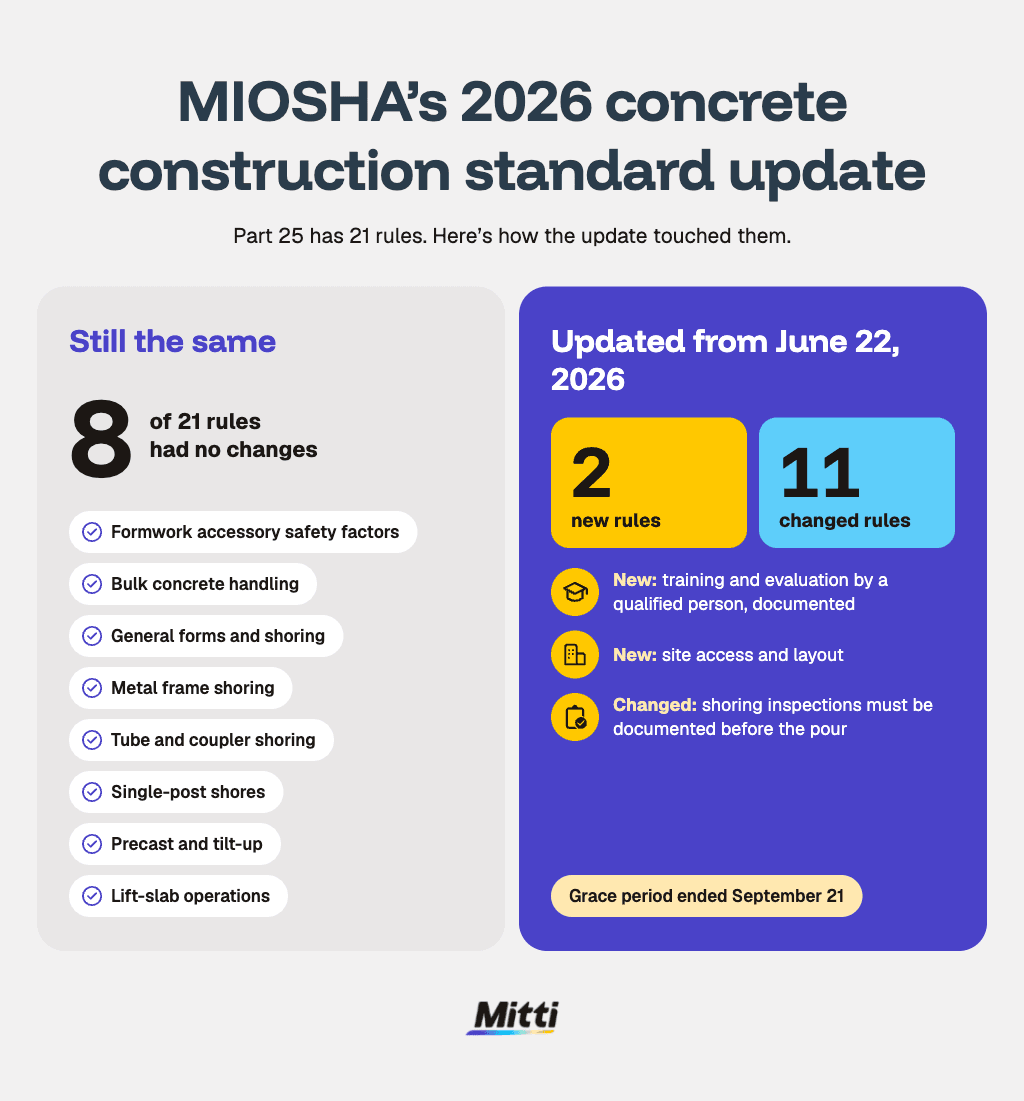
What changed in June 2026 was that Part 25 of MIOSHA’s construction safety standards, which cover reinforcing, pouring, stressing, lifting and floating concrete, plus forms, shoring, tendon tensioning, precast and lift-slab work, was updated.
Here are the main changes:
Training: Employers must make sure each worker is trained and evaluated by a qualified person on the hazards of their work, and keep a record of it.
Site access and layout: Employers must provide a walkway across rebar, access roads for equipment and deliveries, and a firm, drained area to store rebar and post-tensioning materials.
Scope: Some wording updated, such as “prestressed and poststressed” to “tendon tensioning.”
Adopted standards: Updated contact details for getting the standards.
Referenced standards: Updated department names and addresses.
Definitions: Added terms like “barricade,” “sign” and “tendon.” Dropped “qualified designer” and “horizontal shoring beams.”
Reinforcing steel: The rule requiring a walkway across rebar now sits in the new site access rule.
Mixing, pouring and floating: Plan routes for suspended loads ahead of time so no one works underneath them, except when emptying the bucket.
Placing and removing forms: If forms come off based on strength tests, the company doing the stressing needs the test results in writing.
Vertical slip forms: Wording updated.
Vertical shoring: A qualified person must inspect the shoring before concrete is placed, and the inspection now has to be recorded.
Flying forms: Wording updated.
Tendon tensioning: Added signs and barricades, a safe work platform of at least 3 feet and calibration checks for stressing equipment. The old safety-factor requirement is gone.
Part 25 also applies to anyone working near those hazards, according to the revised standard.
Of everything MIOSHA revised, training is the biggest paper-trail change. Your team’s training and evaluation must now be by someone who’s qualified in that specific line of work.
Meaning, one general orientation for everyone isn’t enough. A formwork carpenter and a pump operator are different jobs with different hazards, so each needs training for their own work, whether that’s formwork safety or pump operation.
The good news is that if you already have a procedure or slide deck ready, you can use it for your new hires. Better yet, with digital platforms like Mitti Training, you can upload that PDF file, and AI will turn it into a course your crew can take on their phones. Check it over first, and have your qualified person approve it. The course also keeps a record of who finished it, but the evaluation still has to come from your qualified person.
One inspection that has its own rule is the one done before the pour. A qualified person must inspect and document whether the shoring was erected as specified in the plans before concrete is placed in the forms. With the 2026 update, a pre-pour record is now needed as proof of that inspection.
Meaning, the record has to exist before any concrete goes in. A strong record shows who inspected, when and what they found, and includes photos of anything questionable. Start with a pre-pour inspection checklist and adapt it to your shoring plans.
Several of the amended Part 25 requirements come down to documented proof. An inspector can’t see what you checked before the pour, so your records have to show it.
Also, the rule doesn’t prescribe a form for them, but it does say what has to be kept. Start with what the rule names:
Training and evaluation records for each worker, by task
The documented shoring inspection from before the pour
Shoring and formwork drawings, available at the jobsite
Stressing equipment calibration specifications, kept on site for tensioning work
Keeping all of that straight is easier when you have a platform that records each check as it happens. Platforms like Mitti (by SafetyCulture) keep training completion records, equipment calibration checks and pre-pour inspections with photos and timestamps in one place. If a check fails or a training record is missing, assign an owner and track the fix until it’s closed.


Use this free checklist to check formwork, shoring and rebar, log issues and get sign-off before the pour.
“You are going to get better quality out in the field if you run a clean, quality and safe job. That’s just the way we see it.”


