
NFPA 70E: requirements, training and arc flash rules
NFPA 70E tells you how to keep people safe around energized equipment. Here's what it requires, who it covers and what changed in the 2027 edition.
NFPA 70E tells you how to keep people safe around energized equipment. Here's what it requires, who it covers and what changed in the 2027 edition.
NFPA 70E is the standard for electrical safety in the workplace. The National Fire Protection Association (NFPA) publishes it, and it explains how to protect workers from electric shock, arc flash and arc blast when they work on or near energized equipment.
Think of it as a rulebook for people, not wiring. The National Electrical Code (NFPA 70) covers how electrical systems get installed. NFPA 70E covers how workers behave around them, from risk assessments and lockout/tagout to PPE, training and maintenance.
It isn't a law on its own. NFPA revises it every three years, so check which edition your program follows.
Not by name. Still, the two are closely tied. Treat NFPA 70E as the working layer of your wider electrical safety program. OSHA sets the legal floor and 70E shows you how to build above it.
OSHA's own inspection guidance says its electrical work-practice rule is based largely on NFPA 70E. OSHA has also pointed to 70E as recognized industry practice when it reviews electrical training, procedures and signage. If a worker gets hurt and your program ignores the standard, expect hard questions.
Utilities follow a separate OSHA rule, 29 CFR 1910.269, which already calls for at least two employees on certain energized work. The new 70E additional-person rule builds on that idea for the rest of industry.
The standard applies wherever employees face shock or arc flash risk. That means electricians and maintenance crews, but also plant engineers and anyone who opens a live panel. In the US it lines up with OSHA's electrical standards for general industry and construction. Canada has a close sister standard, CSA Z462.
The standard asks for a written electrical safety program built on three things: a risk assessment before work starts, safe work practices and documented training. Two requirements do most of the heavy lifting.
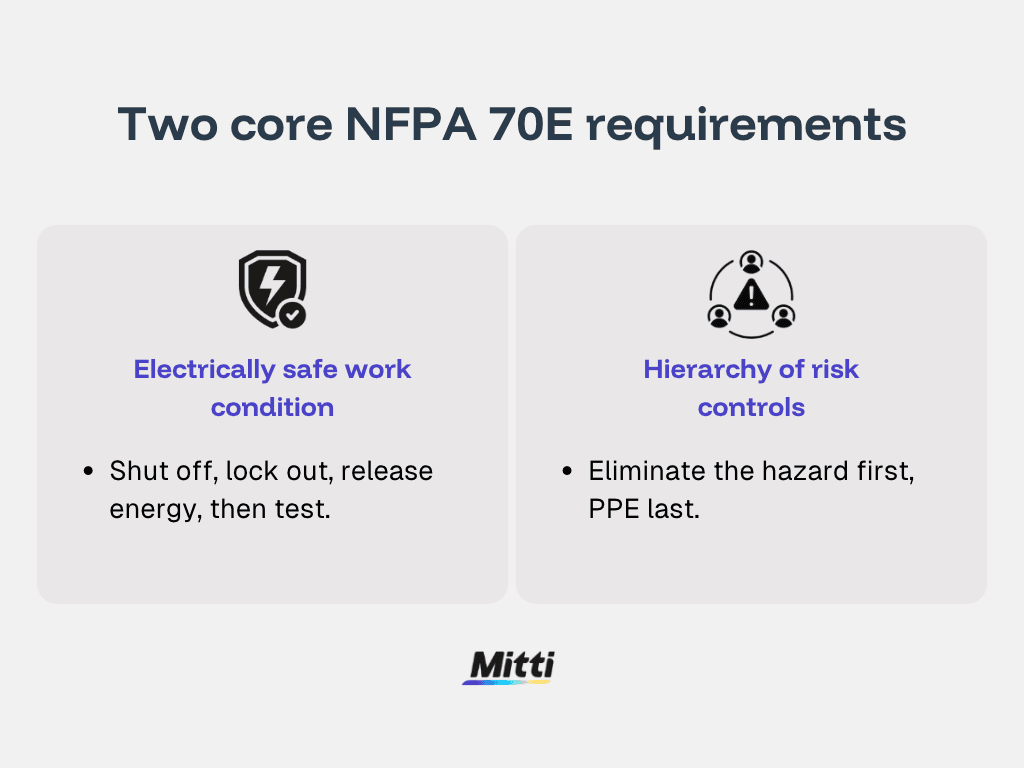
The best way to remove a hazard is to turn the power off. Identify every source of power, shut it off, apply lockout/tagout, release stored energy, then test to prove the equipment is dead. Never skip the test. The 2027 edition also says a voltage test alone doesn't always prove a circuit is safe, and the changes section below explains why.
NFPA 70E puts elimination first and PPE last. That order follows the hierarchy of controls. Before anyone suits up to test a panel, ask whether the job can wait for a scheduled shutdown. If it truly can't, the work is "justified" and needs an energized electrical work permit. The permit records why the circuit can't be shut off, the boundaries, the PPE and who approved the job.
An arc flash risk assessment decides whether a hazard exists. If it does, the assessment sets the arc flash boundary, the PPE and the safe work practices for that task. The boundary is the distance at which incident energy drops to 1.2 cal/cm², the point where an unprotected worker would get a second-degree burn.
You can use incident energy analysis or the PPE category tables. Document the results. Review them at least every five years, and again after any major change to the electrical system. For causes and approach boundaries, see the guide to arc flash.
Labels turn the assessment into something a worker can read at the panel. Each one needs three things:
Nominal system voltage
Arc flash boundary
One of three details: incident energy with working distance (or PPE category, never both), minimum arc rating of clothing, or the site-specific level of PPE
A label that lists results from a 2019 study, on a panel that has since had a new breaker, is wrong. Putting a date on each label makes the five-year review easy to track.
PPE is the last line of defense, but it still has to match the task. NFPA 70E sets four PPE categories, each with a minimum arc rating: 4, 8, 25 and 40 cal/cm². Check the rating on the garment tag against the label, then pair it with the right electrical PPE like a face shield, rubber insulating gloves and foot protection.
Anyone exposed to electrical hazards needs training that fits their job. Qualified workers must be able to spot hazards and use the safe work practices for their tasks. Unqualified workers must at least recognize the hazards and know when to stay back. A warehouse picker who works near switchgear falls in this group. The standard defines a qualified person by demonstrated skill plus safety training, not by a course certificate alone.
Retraining is required at least every three years. It's also needed sooner when someone takes on a task they don't do often. Employers have to document the training and confirm the worker can do the job.
Dates are where programs slip. On a crew of 40, refreshers expire all year long, and nobody notices until an audit. Platforms like Mitti (by SafetyCulture) can assign refreshers by role and flag anyone about to lapse.
Most gaps aren't knowledge gaps. They're follow-through gaps: a label nobody checked, a refresher that lapsed, a permit filled in after the job.
Walk your panels on a schedule and check labels against the latest assessment. An electrical maintenance checklist keeps those walks consistent.
Give every finding an owner and a due date. Roma Food Products raised more than 550 actions in its first five months on Mitti (by SafetyCulture) and closed 96% of them.
Keep training and permit records in one place, so an auditor can see them in minutes.
Put the next revision on the calendar. NFPA publishes a new edition every three years, and your procedures should follow.
Mitti (by SafetyCulture) is the operations system for every site, shift and standard. Trusted by over 80,000 organizations, Mitti brings your people, operational data and workflows into one operating picture.
Your frontline teams get real-time visibility across every site, worker and task. They catch risks earlier, close out corrective actions and build a digital audit trail as the work happens, so you stay audit-ready without the paperwork.
Catch hazards and near-misses the moment they happen
Turn every issue into a clear next step with an owner and a deadline
Stay audit-ready with a digital audit trail that builds itself
Get workers trained and site-ready before they start
Spot trends across sites, shifts and teams
Improve safety every day with evidence from the people doing the work
Article by
Mitti (by SafetyCulture) Content Team
Mitti (by SafetyCulture) Content Contributor
View author profile