Safety management systems (SMS): the complete guide
Learn what a safety management system is, how its four components work and how to put one in place on your site.

Learn what a safety management system is, how its four components work and how to put one in place on your site.
A safety management system (SMS) is a set of company-wide processes that helps your team spot risks and act on them before someone gets hurt. It gives you one structured way to make safety decisions in daily operations. The International Civil Aviation Organization (ICAO) names five key processes: hazard identification, occurrence reporting, risk management, performance measurement and quality assurance.
The main purpose of a safety management system is to give your team a systematic way to manage safety risks. It builds on the processes you already have, so you can act on risks before they turn into incidents. High-risk industries like aviation, energy, maritime and construction rely on it most. In 2024, BLS recorded 1,032 fatal injuries among US construction and extraction workers. On a site, a manager can log a missing guardrail from a phone, assign the fix and see it closed before the next shift.
In US aviation, an SMS is a legal requirement. The FAA’s 14 CFR Part 5 requires airlines to run one, and a 2024 final rule extended that to charter and commercial air tour operators.
Outside aviation, OSHA’s recommended practices lay out a safety and health program built on seven core elements, from management leadership to hazard identification and training. They’re voluntary guidance, and construction has its own version. Many organizations also build their SMS on ISO 45001, the international standard for occupational health and safety management systems. ISO 45001:2018 is the current edition, and a revised edition is in draft.
The OECD’s International Transport Forum notes that SMS principles cut across industries and transport modes. Safety consultant Daniel Maurino compares an SMS to a generator. It doesn’t fix safety problems itself, but it produces the information that powers the programs and decisions that do.
An SMS can feel like a lot to set up. Digital tools make it easier. An AI safety inspection helps you find and fix hazards faster.
Some benefits of having a safety management system include the following:
Better risk management – Use free checklist templates and the form builder to find hazardous conditions, assess risks and set controls on site.
Clearer communication – Workers report issues from their phones and managers see them right away, so important information reaches the right person.
One home for documentation – Store inspections, reports and actions in the cloud so anyone can find them anytime. Your audit trail is ready when you need it.
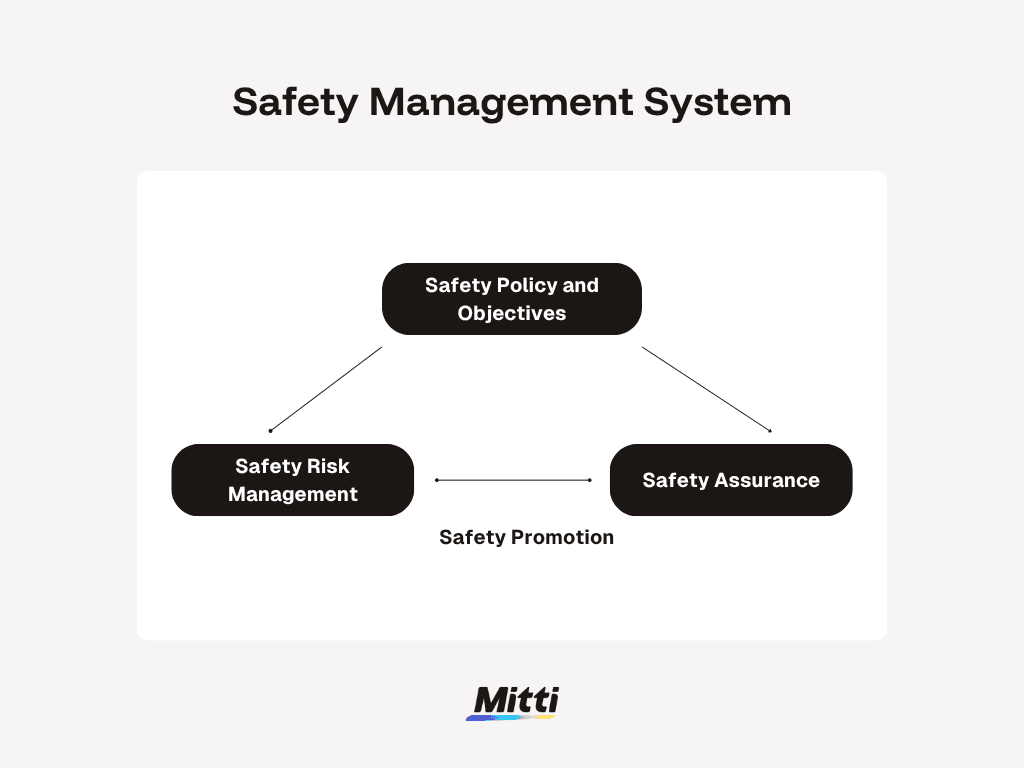
Safety management systems have four components in their framework:
Safety policy and objectives
Safety risk management
Safety assurance
Safety promotion
In practice, an SMS works as a loop. You set policy, find and assess risks, check that your controls work and keep everyone informed. Each component covers one part of that loop.
Each component contains elements that describe what you need to set up and maintain the system. ICAO defined these 12 elements, and many industries have adopted them:
Management commitment
Safety accountability and responsibilities
Appointment of key safety personnel
Coordination of emergency response planning
SMS documentation
Hazard identification
Safety risk assessment and mitigation
Safety performance monitoring and measurement
Management of change
Continuous improvement of the SMS
Training and education
Safety communication
The table below shows how they fit together:
Components | Elements |
|---|---|
1. Safety policy and objectives | - Management commitment - Safety accountability and responsibilities - Appointment of key safety personnel - Coordination of emergency response planning - SMS documentation |
2. Safety risk management | - Hazard identification - Safety risk assessment and mitigation |
3. Safety assurance | - Safety performance monitoring and measurement - Management of change - Continuous improvement of the SMS |
4. Safety promotion | - Training and education - Safety communication |
Make safety part of your company values and show your commitment daily. Top management sets safety goals as policy and stays visible and personally involved in meeting them. Once you’ve named your safety personnel, decide how you’ll document the system. Review it regularly so it stays relevant to your organization.
To control safety risks, designated staff run a series of connected processes called safety risk management (SRM). It has five steps:
System description and task analysis – A cross-functional team describes the system and breaks down each task. They record the facts about the activities, equipment and conditions involved.
Hazard identification – A hazard is any real or potential condition that can cause injury, illness, death or damage. That includes human factors like time pressure, shift turnovers and gaps in system knowledge.
Risk analysis – Look at how likely each hazard is to cause harm and how severe the harm could be. One hazard can lead to several consequences, and more exposure makes serious ones more likely.
Risk assessment – Use a risk matrix to decide whether each risk is acceptable. If it is, the risk moves on to safety assurance for monitoring. If it isn’t, put controls in place.
Risk control – Controls usually cut the likelihood of harm more than its severity. Apply them to working conditions to reduce risk and prevent failures.
Sample risk matrix for the safety risk assessment element of SMS by FAASTeam

Safety assurance (SA) monitors your risk controls during operations. Common SA functions include internal audits, investigations and employee reporting systems. Analyze what you gather against your objectives. Look for patterns across data points and trends over time. Risk controls often fail because of a lack of leadership, resources or instruction, so take preventive and corrective action either way.
Safety promotion covers the activities that support safety culture, such as training, knowledge-sharing, communication and observances like National Safety Month. Explain why you take particular actions. That builds an environment where people report safety concerns openly.
Most teams can follow the same six steps, whatever the industry. How long it takes depends on your size and how many sites you run.
Run a gap analysis – Compare your current safety processes with the four components. Note what’s missing or informal.
Set your safety policy and goals – Get leadership to sign the policy and name who owns safety at each level.
Identify hazards and assess risks – Use job safety analysis, worker reports and the five-step process above. Rank risks with a risk matrix.
Put controls in place and train your team – Assign each action an owner and a deadline. Train workers on the new process before they use it.
Track performance – Monitor your KPIs and run regular safety audits to check your controls work.
Review and improve – Review results with leadership and update the system when your operations change.
Track a few indicators and review them on a set schedule. Mix leading indicators, which show your effort, with lagging indicators, which show outcomes. Good ones to start with:
Hazards reported and closed – Shows whether people spot problems and your team fixes them.
Corrective actions closed on time – Shows whether risk controls get done.
Inspections completed on schedule – Shows whether checks happen as planned.
Training completion rate – Shows whether workers are ready for their tasks.
Near-miss reports – A rise often means people trust the reporting process.
Total recordable incident rate (TRIR) – Shows how many recordable injuries and illnesses happen per 100 full-time workers in a year.
Review these with leadership on a regular schedule and act on what they show.
Some use cases for safety management systems include the following:
Construction – A site manager logs a hazard from a phone, assigns the fix and checks it’s closed before the next shift.
Manufacturing – Supervisors run equipment checks every shift and spot near-miss trends before they cause downtime.
Transport and logistics – Teams run vehicle pre-starts and load inspections so the fleet stays compliant.
Small business – A small team starts with one hazard checklist and one reporting process, then adds audits and training as it grows.
Training helps your team put a safety management system into practice, as OSHA explains in its guidance on implementation and effectiveness. Good sessions cover the steps and obligations of the system. Workers learn to:
Spot hazards
Follow safety procedures
Respond to emergencies
Regular training also keeps you compliant with changing safety standards. It updates people on new processes and procedures as they arrive.
Online courses let your team train anytime, anywhere and at their own pace. Platforms like Mitti (by SafetyCulture) let you check that workers are trained and site-ready before they start.
Mitti is the operations system for every site, shift and standard. Trusted by over 80,000 organizations, Mitti brings your people, operational data and workflows into one operating picture.
Your frontline teams get real-time visibility across every site, worker and task. They catch risks earlier, close out corrective actions and build a digital audit trail as the work happens, so you stay audit-ready without the paperwork.
✓ Catch hazards and near-misses the moment they happen
✓ Turn every issue into a clear next step with an owner and a deadline
✓ Stay audit-ready with a digital audit trail that builds itself
✓ Get workers trained and site-ready before they start
✓ Spot trends across sites, shifts and teams
✓ Improve safety every day with evidence from the people doing the work